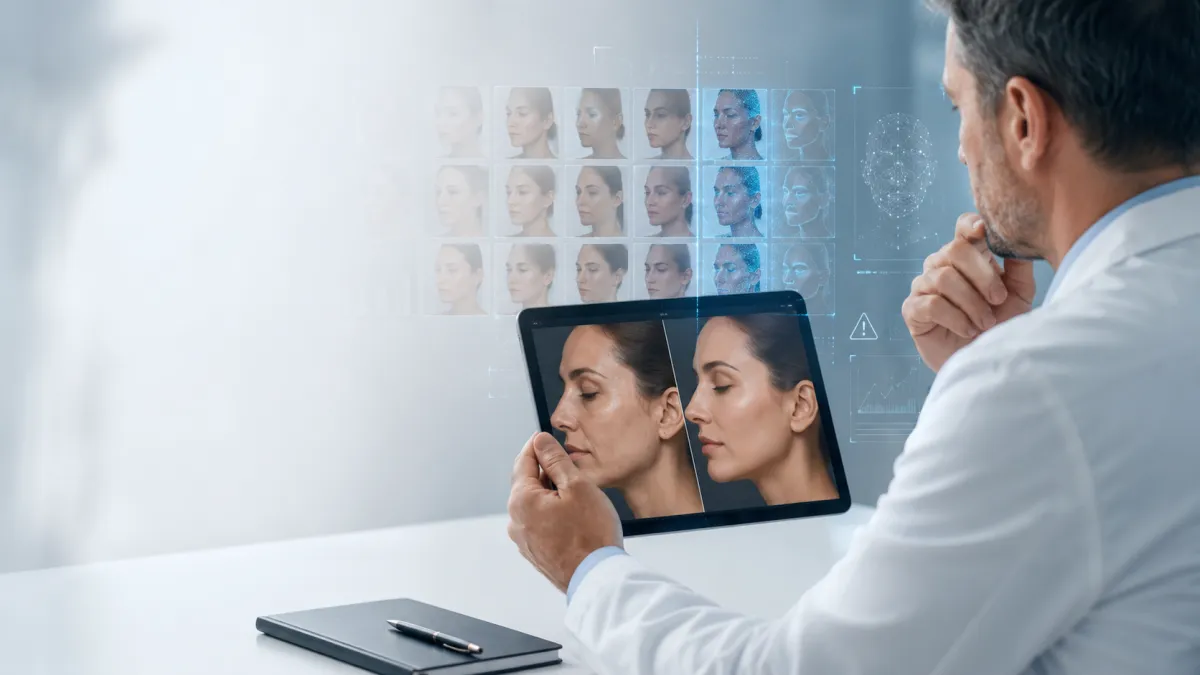
AI Is Changing Doctors’ Before-and-After Photos
AI In Medical Marketing, Medical Marketing Trends, Patient Engagement
AI Is Changing Doctors’ Before-and-After Photos: It Is Becoming Harder to Know What Is Real
For years, before-and-after photographs have been one of the most widely used tools by doctors and clinics to showcase results and build trust with patients. They still carry considerable weight: a study published in the Aesthetic Surgery Journal found that 87% of patients considered these images important when choosing a practitioner for an aesthetic treatment.
However, artificial intelligence is changing the context in which those images are now being viewed. “We are reaching a point where an image, no matter how impressive it may be, is no longer enough on its own to build trust. Patients know that today a photograph can be edited or even created from scratch in a matter of minutes,” explains Nils Dávila, a consultant specializing in medical marketing and patient acquisition.
Today, all it takes is opening Instagram or TikTok to come across dozens of striking transformations and seemingly perfect results. At the same time, image editing and generation tools have become much more accessible, making it increasingly difficult to know exactly what we are looking at.
A study published in the Proceedings of the National Academy of Sciences showed just how difficult it can be to distinguish between what is real and what has been generated by artificial intelligence. Participants struggled to tell real faces apart from AI-generated ones and, in one of the experiments, even rated the synthetic faces as more trustworthy.
For Dávila, this does not mean doctors should stop publishing before-and-after images. On the contrary, they remain a highly effective way to show results. What is beginning to lose value is publishing them without any additional context.
Showing the result is no longer enough
![put a realist before and after in face [Brand guidelines: use brand color palette #063851, #F0810E, #E5DF43]. Context: This is for a blog post about "How AI Is Changing Before-and-After Photos in Medical Marketing". Style: Professional quality, photorealistic, high resolution](https://images.leadconnectorhq.com/image/f_webp/q_80/r_1200/u_https://storage.googleapis.com/funnel-ai-production/blog-ai/Gz3LsrJqxZIlynQqbEMd/blog-1787669382682-hyppcl.png "put a realist before and after in face [Brand guidelines: use brand color palette #063851, #F0810E, #E5DF43]. Context: This is for a blog post about \"How AI Is Changing Before-and-After Photos in Medical Marketing\". Style: Professional quality, photorealistic, high resolution")
Most before-and-after posts found on social media still follow a similar format: an image taken before the treatment, another one afterwards, and a brief description of the procedure that was performed. The problem is that while this format allows people to see the change, it reveals very little about the professional behind it.
“If everyone can show spectacular results, the result itself becomes less useful in explaining why a patient should choose you. That is where showing the doctor’s clinical judgment starts to become much more valuable,” says Dávila.
That judgment can be found in many of the details that are usually left out of the post: what the doctor noticed when assessing the case, which alternatives were considered, why a particular technique was chosen, which limits were deliberately respected, or which aspects the doctor decided were better left unchanged.
A plastic surgeon, for example, could show the result of a rhinoplasty and explain why a conservative change was chosen instead of trying to create a completely different nose. An aesthetic doctor could explain why they advised against a treatment the patient had initially requested, or why they believed a different option was more appropriate.
“When you explain the decisions behind a case, the patient starts to understand how you think as a doctor, and that can say much more about you than a photograph alone,” explains Dávila.
Clinical judgment as a point of differentiation
Artificial intelligence will make it increasingly easy to produce images, videos and other content that looks visually perfect. As a result, that visual perfection is likely to gradually lose some of its ability to differentiate one professional from another.
Clinical judgment works differently. It is built through training, experience and exposure to hundreds of different cases, and it becomes especially visible in the decisions a doctor makes when several possible options are available.
From a medical marketing perspective, this also represents a shift in the way doctors communicate. The opportunity is no longer simply to demonstrate that they achieve good results, but to help patients understand why they make certain decisions and how they would approach a case similar to their own.
“AI is going to make it easier and easier to produce perfect-looking content. That is why I believe medical marketing will have to rely less on appearing perfect and more on demonstrating judgment. An image can be copied or manufactured, but a way of thinking built over years of experience is much harder to replicate,” says Dávila.
Before-and-after images are not going to disappear, and they will probably continue to play an important role in the way many clinics communicate. What may change is their function: the photograph will continue to show the result, while the explanation will help patients understand the professional behind it.
Because in an internet full of perfect results, the real differentiator may ultimately be something far more human: the doctor’s judgment.